Tuesday, October 6, 2009

Camel crossing & a night in the desert - Wadi Rum, Jordan

Stats:

Destination: Wadi Rum, Jordan

Number of Days Spent: 2 days

Where we stayed: Wadi Rum Tours (www.wadirumtours.net) - 30 JD/person including lunch, dinner, tea & water ($45*2=$90). We really liked this camp which was recommended to us by other travelers. It's located within Wadi Rum at an excellent sunset spot and is one of the few that offers running water (it's even hot from the sun for that sunset shower) and flushing toilets. As a bonus it's the same price as the others booked at the Wadi Rum entrance. Note that it must be booked in advance, the owner Obeid will fetch you from the entrance and take you to the camp.

Best restaurant: The dinner at the camp was pretty tasty, it included chicken baked in a zerb (an oven in the sand), a vegetarian dish, rice, salad & coke.

Best of: Sleeping under the stars in Wadi Rum & waking up to the sun rising over the rock formations! Beautiful!

Worst of: Our camel ride was an overpriced joke. We should have taken one from the visitor's center as they are about half the price of the camps. If you want to take one make sure you state where you want to go otherwise you may end up just wandering through the desert without a destination. They should run 7 JD per hour and our camp was charging 15 JD per hour. But at least we only booked an hour, the 3 other people at our camp booked 2 hours at 30 JD which was of course an even bigger rip off. Unless you really love riding a camel an hour is probably enough time. I guess we can still say we rode a camel where Lawrence of Arabia rode one which makes up for some of the extra cost.

Most Memorable: Climbing up our first sand dune in the mid-day sun (not so good)...then flying down it (great)!

Useful tip: Make sure your lodge is located within the confines of Wadi Rum. There are many camps operating on the outskirts. Beware of people that approach you on the bus on the way in claiming to be from this and that camp. They usually want to sell you a tour, camel ride or lodging at a place outside the reserve. The prices are strictly regulated by the park so if they tell you a deal that's too good to be true it probably is.

After all the Biblical history of Mt. Nebo and the Jordan river, it was time to fast forward into the 20th century and head out into the desert Lawrence of Arabia style. In his book, Seven Pillars of Wisdom, Lawrence writes fondly of this stretch of desert along the southern reaches of present day Jordan. It is here before and during WWI that Lawrence recruits and gathers Arabs to fight for independence from the Turks. Aside from a makeshift house and a few inscriptions, little remains from Lawrence's day. The real star of the show here is the landscape.

IMG_3578 [640x480] IMG_3583 [640x480]

After settling into our camp, we took off for a quick one hour jaunt through the desert thanks to our new four legged friends, a couple of camels. It was in the desert and in the same area where Lawrence would have rode, but that is where the comparisons end. Our short jaunt consisted of an overly bored kid leading a couple of tourists on a walk in circles near the camp. To make matters worse, he forgot his watch so every couple of minutes he would ask what time it was to make sure we didn't go over our hour. I finally gave up and handed him the watch.

IMG_3593 [640x480] IMG_3652 [640x480]

IMG_3607 [640x480] IMG_3615 [640x480]

We have seen a lot of sunsets in quite a few places, but this one ranks up there as one of the best. Perhaps it's the solitude and peace that comes with witnessing such events without all the noise of traffic or an overcrowded beach full of people. Or maybe it's the way the sun sends it's final rays over the rocks only to have the remaining hills illuminated in a magnificent glow. But I think the best part of watching a sunset in a desert such as this is how clear the sky becomes at night. That night, after dinner, we pulled our mattress and blankets from the tent and slept out under the heavenly skies. The air temperature perfect, the eery sound of silence, and a canopy of thousands of twinkling lights sets the stage for the best night of sleep you will find anywhere.

IMG_3633 [640x480] IMG_3673 [640x480]

With our batteries fully recharged, we arose early and set out with Obeid, our host and guide, on a four wheel excursion through the desert. The area has been home to traveling nomads for thousands of years as evidence from carvings on the walls. The carvings would help early Bedouin find their way back to the handful of springs and help lead the way to the next outposts along the trade routes.

IMG_3694 [640x480] IMG_3704 [640x480]

IMG_3710 [640x480] IMG_3707 [640x480]

Part of the natural beauty, several of these rock "bridges" were formed through erosion. We took a quick climb to the top of this one and peered over the edge. Not a good place if you are afraid of heights...or perhaps a good place to conquer that fear.

IMG_3721 [640x480] IMG_3847 [640x480]

Sand, sand and more sand. While it's all fun and games at the beach or in a box in the backyard, the real deal is a different story. From a distance, climbing a sand dune seems rather straight forward and easy. After taking a couple of steps however you quickly realize it's a difficult task. Not only do you sink and slide almost as much as you gain, but the hot sand adds more misery as it falls in around your legs when you sink. The only relief is to dig in and find the cooler sand several layers below. At least you are rewarded after reaching the top by getting to some down...fast!

IMG_3811 [640x480] IMG_3822 [640x480]

IMG_3829 [640x480] IMG_3835 [640x480]

After having our fun in the rather unorthodox version of sun and sand, sans surf, we packed up the car and made our way to the lost civilization of Petra, or aka, the home of the Holy Grail according to Steven Spielberg.

To see more photos of Wadi Rum click here!

Tuesday, September 29, 2009

Floating in the Dead - Madaba and the Dead Sea, Jordan

Stats:

Destination: Madaba, Jordan

Number of Days Spent: 3 days

Where we stayed: Mariam's Hotel (30 JD - $42 with breakfast, a pool, 24 hour hot water, wifi & clean rooms)! A godsend after the place in Azraq and much better value for your money than Jerash.

Best restaurant: There was another great, no name (only in Arabic) falafel place in Madaba about 50 meters from St. Georges Church next to Arab Bank and across from Al-Baraka Sweets. Sandwiches were about $.50 each.

Best of: Bobbing up and down in the Dead Sea, staring out over the expanse just as Moses did to see the promise land from the top of Mt. Nebo, scenic drives and pausing to let the sheep to cross the road.

Worst of: The overly protected holy spot of Jesus' baptism along the river Jordan. Since the site is No-man's-land, the only way to see it is on a guided tour.

Most Memorable: Hot, hot, hot - temperatures soar at the lowest point on Earth - at over 1200 feet below sea level temperatures rose above 50 Celsius (113 Farenheit). Trying to wipe salty sweat away with our even saltier hands was quite a challenge.

IMG_2581

We based ourselves in Madaba to explore the surrounding areas of the Dead Sea, Bethany-on-the-Jordan, Mt. Nebo, Karak and Madaba itself. Madaba turned out to be an excellent base with several choices of hotels (Yeah! Competition means better prices and more for your money!) and restaurants. The town was an important Roman town and flourished during the Byzantine period where many churches were built and adorned with colorful mosaics. The city was abandoned after an earthquake in the 8th century for 1100 years until the Christians once again settled the town. With the discovery of the mosaics, the town became an important archaeological site as excavation continues till this day. The town is still 1/3 Christian (2/3 Muslim) today which is one of the largest Christian communities in Jordan.

Arriving from the desert castles we set off to explore the major sites of Madaba, namely the Church of St. Georges. The church is the star attraction in Madaba due to an impressive mosaic map. Built in 560BC, the mosaic is the oldest existing map of Palestine. The mosaic includes historically and religiously important sites such as the RIver Jordan (complete with tiny mosaic fish swimming upstream away from the too salty to live in Dead Sea), Jerusalem, Jericho, Mt. Nebo & the Nile Delta.

IMG_2595IMG_2592

IMG_2582 IMG_2587

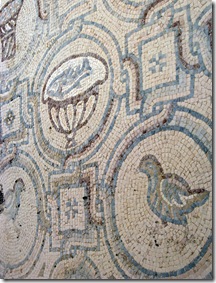
Madaba also has an impressive archaeological park. Many of the mosaics dug up from people's basements wind up here and are on display along side parts of the old Roman streets. Known for its mosaics throughout the region, Madaba and the park are also home to a workshop where the ancient art form is taught to future generations.

IMG_2597IMG_2600

"Go up unto Mt. Nebo in Moab, across from Jerico, and view Canaan, the land I am giving the Israelites as their own. Their on that mountain, you will die." ~ Deuteronomy 32:49-50

After saving the Israelites from the bondage of Egyptian slavery, Moses led the people to this spot where he looked out on the promise land during his final days. While the actual site of his burial is of much debate, there is no denying that on a clear day you can see all the way to the walls of Jerusalem 45 kilometers away from the top. This day was not such a clear day, but we could still make out the outline of a city on the other side of the Dead Sea. The church on top was closed when we were there but is said to have some nice mosaics from around the 4th and 5th centuries.

IMG_2606 IMG_2605

IMG_2611 IMG_2614

The site of Jesus's baptism is said to be at Bethany-beyond-the-Jordan (yes, that is the actual name). In biblical times, "beyond" referred to the other side of the river, or in this case, the east side. Remains of churches dating back to the 5th and 6th centuries and early accounts of pilgrimages further solidify this place as the site. It is also believed to be the area where Elijah ascended into heaven upon his chariot of fire in a whirlwind. While you can still get the sense of spiritual significance, the site today is marred by politics. Armed Jews (Israel) on one side of the bank along with armed Muslims (Jordan) on the other keep a watchful eye on tourists and people of pilgrimage alike assuring no one crosses the boarder. While relations have improved in recent years, and the site is opening up more and more (there were in construction 9 churches of differing sects), the guards still serve as a reminder that little has changed.

IMG_2623IMG_2630

IMG_2627IMG_2628

Our last stop of the day was at the Dead Sea itself. The appropriately named body of water gets it's name from two sources: the prized mud was used in the mummification process in Egypt and the salinity is so high that nothing can live in its waters. Whether taking a dip on the Israeli side or the Jordan side, a trip to this area is not complete without "Bobbing in the Dead." At 508M (1339 feet) below sea level, the Dead Sea is the lowest and one of the hottest places on Earth. The drive down also provided some stunning scenery as you pass multi-hued rock and sand formations. The Sea itself is actually a basin where the Jordan River terminates and the heat evaporates off the water resulting in a body of water that is 9 times saltier than the ocean (around 31% salinity).

Given its healing properties and rich nutrients in the mud, the area has largely been turned into resorts and spas. The Jordanian government, thankfully, decided to make a public beach and charge about half what the spas charge - still pricey at around $15 per person, but oh so worth the experience. Where else can you read the newspaper while taking a swim? With the water temperature around 100F and the air temperature soaring well above 110F during the midday heat, it doesn't take long before the sweat begins to bead on the forehead. Then you are left with a problem - the salty sweat runs into your eyes and you can't wipe away the sweat with your even saltier wet hands from the water! We lasted about 30 minutes before it became too much to bare. We didn't plan our exit out too well either as we left our shoes at the top of the scorched sand bank. Don't worry though, we got the feeling back in our feet after an hour or so.

IMG_2638 IMG_2687 [320x200]

IMG_2656 [320x200] IMG_2668 [320x200]

After leaving the Madaba area, we made one last Crusader Castle stop at Karak. The castle was one of many that were built by the Crusaders to not only protect Jerusalem from attacks, but just as important, collect taxes from the trade routes and help fill Jerusalem's coffers. Karak became the stuff of legends when the sadistic French Renauld de Chatillon came to take part in the crusades and stationed himself here. Chatillion delighted in torturing prisoners and then throwing them from the castle walls to their demise. This behavior brought the ire of the famous Islamic leader, Saladin. When the castle was taken, the Muslim leader executed Chatillion, the only crusader leader to receive such a fate. Wandering though the castle is a delight as many of the rooms remain intact. Highlights include an impressive covered marketplace lined with shops and stalls, a massive kitchen including a walk in oven, and a post-crusader Sultan's palace.

IMG_3548 IMG_3555

IMG_3560 IMG_3564

IMG_3563IMG_3573

After leaving the crusader castle, we headed further into the desert and made our way to our next stop: The beautiful desert park of Wadi Rum.

To see more photos click on the links below:

Madaba

Mt. Nebo

Bethany

Dead Sea

Karak

Tuesday, September 22, 2009

Welcome to 8th Century Pleasure Palaces: The Desert Castles of Jordan

Stats:

Destination: Desert Castles of Jordan (near Azraq)

Number of Days Spent: 2 days

Where we stayed: Azraq Resthouse - 40 JD ($56 - overpriced, we suspect not very honest, not very clean and the rooms are way past their prime but it did have a great pool which was very welcome after a day in the desert. There were only 3 choices in this dusty little town...it was this one or the one with the dirty looking bathroom, complete with squat toilet...the most desirable lodging was booked up, we suspect by a single tour group because our hotel had only one other room occupied and the squat toilet one was empty)

Best restaurant: No name chicken house (name is only in Arabic) in Azraq -8 JD for a barbecued chicken, a huge plate of fatoush, Arabic bread & a plate of fries - it was enough for both of us with room to spare...luckily we had a fridge and our leftovers made for tasty chicken sandwiches for breakfast! Look for the restaurant off the main drag with the barbecued chickens out front but don't confuse it with the mutton roasters.

Best of: Islam's first pleasure (aka pervert) palace, complete with naked ladies, clapping monkeys & bears playing banjos!

Worst of: I wouldn't suggest this town as a stopover, its claim to fame seems to be grilled mutton. Not only did we see the poor things being slaughtered, skinned & hung up in front of the restaurants on the street but the air was heavy with the distinct smell of old, smelly mutton and the sounds of their demise. We also ran across two restaurants serving beef, complete with the whole cow head posted outside the restaurant. No thanks..we'll stick to the barbecued chicken...

Most Memorable: We'll never forget the smell of diesel fuel & grilled mutton wafting through the air.

Just to the east of Amman lies what is collectively known as the Desert Castles. Built by the Umayyads, the first Islamic leaders, or caliphs, based in Damascus, the castles are really a collection of castles, palaces and inns. The elite Islamic leaders built these "oases of pleasure" in the middle of the harsh desert as an escape from the strict religious practices they preached. In these private getaways, the wine flowed, the women danced and the men hunted and held horse races. While most of the buildings are modest affairs from the outside, the walls contain some great stories of days gone.

Leaving Jarash, it didn't take long before we left the farmland and were into the rocky and unforgiving desert. It is out here that Bedouins seek out an existence herding animals from one spot to another as they have for centuries.

IMG_2509 IMG_2529

IMG_2485IMG_2487

IMG_2492 IMG_2507

Our first stop was at Qasr Hallabat. Hallabat began life as a Roman outpost, later converted to a monastery, until the Umayyads added elaborate baths, a mosque, and colorful frescoes and mosaics. The fort today has a few great mosaics, and scattered amongst the Islamic ruins you can see the evidence of the earlier Romans with Latin inscriptions carved into a few of the building blocks.

IMG_2499 IMG_2500

IMG_2508IMG_2504

Just on the outskirts of the forgettable town of Azraq lies Qasr Azraq. While the fort is the least impressive on the circuit and was nearly completely destroyed by an earthquake in the 1920's it does boast one claim to fame. In the winter of 1917 TE Lawrence, aka Lawrence of Arabia, set up camp in this fort with his troups getting ready for battle against the Turks during WWI and the Arab revolt.

IMG_2511IMG_2513

IMG_2518

After spending the night in Azraq (rather forgettable town - see above) we headed out for the last two of the major desert castles. Qasr Kharana is one of the most intact and photographed of all the castles. This imposing structure boasts what looks like towers and narrow arrow slots in the walls at first glance. Once inside you realize that the towers are solid rock and the slits are to awkward to be used for shooting arrows. It is now believed that this structure served as an inn on trade routes and pilgrimages to Mecca.

IMG_2578 IMG_2568

Our final stop on the desert castle tour led us to Qusayr (little castle) Amra. Amra was the highlight of our trip out to the desert. The current structure is believed to be built by the same caliph that built the famed Dome of the Rock in Jerusalem as well as the Umayyad Mosque in Damascus. Unlike those two buildings however, this UNESCO heritage site has the best preserved frescoes that give a glimpse into what the caliphs might have been up to in the far reaches of the desert away from the watchful eyes of the faithful. The frescoes range from rather innocent scenes of hunting to more risque scenes of naked women bathing and even a bear playing a banjo with a money dancing in tune?!? While the official line of Islamic scholars blame the paintings on other groups of Arabs or rogue rulers, the evidence strongly points to the caliphs being the culprits.

IMG_2531 IMG_2535

IMG_2533IMG_2552

IMG_2559 IMG_2556

After getting our feel of 8th century "sin" city, we drove off to the Mosaic capital of Jordan, Madaba.