
Stats:
Destination: Damascus, Syria
Number of Days Spent: 3 days
Where we stayed: Sultan Hotel - $55 - Hotels in Damascus are very expensive and there are only a few budget hotels that book up fast. We suggest booking this city in advance in order to secure reasonably priced accommodation. A lot of travelers that we met recommended Al Ghazal. The guy at reception was really friendly and the reception area was nice.
Best restaurant: The ice cream shop, Bekdach, must be world famous because people literally flocked to it. Located in the souq you couldn't go more than a few minutes without seeing someone licking a cone. The ice cream is made with shellab, a semolina batter (sounds strange, we know, but it's good), and were topped with crushed pistachios. We enjoyed one cone each day as we walked into the old city through the souq (1 cone - 50 pounds - $1) though on our last visit we were a little dismayed to see this fellow smoking his cigarette on one hand and dishing up ice cream in the other (see the gloved hand).


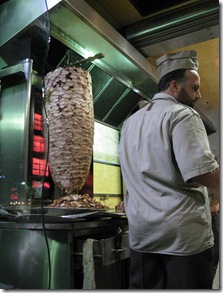
We also liked the schwarma from Anas Chicken (located way south of the city center on Al-Midan Jazmati). They were small but cheap & tasty ($1.25), probably among the best schwarma we tried. Skip the chicken though, there are far better roasted chickens to be had in the Middle East. The fries are delicious especially when dipped in the garlicky sauce they come with.
Best of: Getting lost in the winding, narrow streets of the Old City...on purpose; The glimmering mosaics of the Umayyad Mosque, one of the most important Mosques in Islam
Worst of: The hideous cloak that foreign women have to adorn to go into the Mosque, despite being already covered head to toe.

Most Memorable: Watching the seemingly modest Muslim women shopping for lingerie in the souq...one skimpy number little more than string holding a couple of hearts in select places hung in a shop window our first pass through the souq, later on it was sold!

Simply saying the name Damascus conjures up a mystical and mysterious air. Steeped in history and significance far reaching, Damascus shares the disputed title of longest inhabited city in the world with a few of its neighbors, but few of those cities can match Damascus in importance. Since recorded times, the city has been fought over and conquered by the Egyptians, then came King David and the Israelites, followed by the Assyrians, Persians, Alexander the Great, Nabataeans (of Petra fame), and then finally the Romans. After the Roman empire fell apart, the city came under Islamic rule and the Umayyad Caliphate chose Damascus as the new seat of Islam, built a magnificent mosque, and solidified the city's importance to the Muslim world. Today, Damascus is a thriving metropolis still oozing with history, but also embracing the future with reluctant arms. Syria is still a conservative Muslim country and the capital reflects that in many ways.
The National Museum houses some rather interesting and impressive finds from around the country. A small tablet, not much bigger than a pack of playing cards, has inscribed on it the earliest alphabet in the world found so far. The other two highlights of the Museum seem a bit out of place. The well preserved Hypogeum of Yarhai was deconstructed from Palmyra and brought here in whole so that early visitors to Syria didn't have to make the once dangerous trek across the desert to see it. While it really belongs in Palmyra with the rest of the burial chambers, it's still an impressive array of carvings and tombs. The last highlight is a Synagogue dating from the 2nd century. As strange as it is that the synagogue survived in the first place (thanks to the shifting sands of the desert) it also contains some interesting frescoes depicting scenes from the Old Testament; also another oddity given the Jewish law against depictions of the human form.


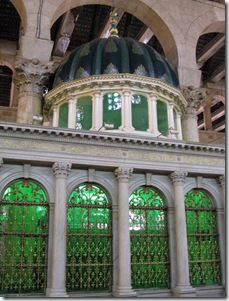
A trip to Damascus is not complete without taking a step inside the beautiful Umayyad Mosque. Despite Tracy being covered, including a scarf over her head and a long sleeved shirt, the nazi like modesty police made her wear the grey cloak anyways...a fact she was none to happy about. After we were sufficiently covered for Allah, we checked out the very modest Mausoleum of Saladin. The famed enemy of the crusaders, Saladin died here and his tomb is a simple affair, much like how he preferred to live his life just outside the Mosque. The mosque itself has three distinctive minarets, the old one (Bride), the pretty on (Al-Gharbiyya), and the tallest one (Jesus - named this as local tradition holds that Christ will appear here in Judgement Day as opposed to Jerusalem). Entering through the threshold of the Mosque gives way to the courtyard with it's impressive golden mosaics. The scenes depict beautiful domes, towers and forests, supposedly the vision Mohammed had when he gazed upon Damascus and refused to enter stating he "only wants to enter paradise once." Like most Mosques, the inside prayer hall is a simple affair, carpeted flooring scattered with worshipers. One interesting addition, and a bit out of place is the glowing green shrine of John the Baptist. The mosque was built over the basilica of John the Baptist and during the building of the mosque a casket was found in the floor with a head of what must be John himself. Unless John had multiple heads, the subject is still up for debate as several places make the same claim.



Shedding our temporary overly modest attire, we exited the mosque and rounded the corner heading into the heart of the Old Quarter. Our personal highlight of Damascus was just wandering around, no real destination in mind, taking in the sights and sounds. With a city so old, the streets are more created around the buildings than the other way around in modern city planning. As a result, the streets snake and wind though the 2-3 story high buildings ever eluding to what lies around the corner. Occasionally a door will open giving way to the inner courtyards that are hidden by the unassuming walls. After wandering around, getting a little lost, and then finding our way again thanks to a little help from an American studying Arabic here, we found the chapel of Ananias. On the road to Damascus, Saul of Tarsus, a Jew sent to arrest Christians living in Damascus, was blinded by God. It was in this house, the house of Judas, that Ananias cured Saul of his temporary blindness and Saul became Paul the Apostle converting to Christianity.


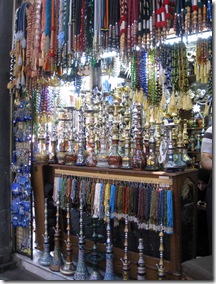
The Damascus Souq is a wide covered lane resembling more of an airplane hangar than shopping mall. Underneath its high ceilings sits just about any item imaginable for sale. From the staples of silver, gold and clothing to the piles of spices, prayer beads and halal cookbooks it can all be had here.


Damascus is filled with old homes that are built in a common style: Basic and simple hallways gives way to a open and breezy inner courtyard surrounded by rooms. We took a peak into Azem Palace, built in the mid-18th century by the then governor of Damascus. While it follows the same layout as most homes, the interior is far more grand and opulent. The palace houses several courtyards, fountains, and even boasts its own hamam (Turkish style bath). There are also a few rooms with kitsch mannequins depicting life in Damascus from weddings to glass blowing.


After getting our feel of Damascus, it was time to wave goodbye to Syria. From the 10 hours at the border till now, we found all the people of Syria we encountered to be warm, friendly, and inviting. While we felt we covered the sights well enough, one could spend days and days just getting to know the culture and people that make up a unique country.
Next stop - across the border to Jordan and the Roman ruins of Jerash.


