Monday, September 15, 2008

The Cultural Capital of Bali: Ubud - Part 1

Stats:
Destination: Ubud, Bali
Number of Days there: 6
Our Best of: Awesome hotel, cheeky monkeys, Kecak Fire and Trance Dance
One thing unexpected: Hawkers and touts can be anywhere, even on countryside walks and on motorbikes pulling up next to your motorbike while driving!
Times we took the: Bus: 0 Train/Subway: 0 Taxi/Car: 2; Motorcycle: 1
Estimated KM walked: 25 (two long hikes around the countryside of Ubud area)
Where we stayed: Hibiscus (hibiscuscottages@hotmail.com; phone number 0361-970475) - Rp 160,000 (US $18) including a huge breakfast and coffee/tea all day long

*HIGHLY recommended, this little hotel has 5 rooms that are in the Balinese house style. For $18 per night you get a huge room with Balinese furniture & a bathtub big enough for 4 people (not that we tried), your own private terrace with unlimited coffee & tea throughout the day AND a free breakfast with a massive plate of fresh local fruit and your choice of pancakes, eggs or french toast. It's located 5 minutes walk from town in the middle of a quiet rice paddy with a nice view! It is situated next to Ala's Hibiscus in the Lonely Planet book (run by the same family). Just bring a flashlight if you're out late at night because there are no lights in the paddy.

Favorite Restaurant: Roda's Restaurant - chicken curry or mixed rice with meat - RP 15,000 (US $1.50) & Our hotel - banana pancakes, banana shakes & fresh fruit (free breakfast with room) & Warung Babi Guling - roasted suckling pig (around 10,000 RP - US $1 - located on the road on the way to lake temple - not in Ubud)

Day 1 - Lekong Dance

We took a shuttle from Kuta to Ubud (RP 55,000 per person - roughly US $6) which took about an hour. Naturally the shuttle dropped us off at the furthest point in Ubud from our hotel so we trekked through town with our packs to our hotel. After relaxing on our lovely porch with complimentary tea we went out to explore town. Ubud is located in south central Bali and is the other main tourist mecca in Bali outside of Kuta. Lining the hillside all around the town of Ubud are artisans selling their handmade goods. Silver, woodcarvings, paintings, and textile items (sarongs mostly) seem to be the most popular made goods here, but you could decorate your entire home inside and out no problem with handmade goods. The town of Ubud itself is crowded, busy, and full of the same hawkers lining the streets of Kuta (Transport? Taxi? How about tomorrow?). It's best to stay just outside of town and spend your days exploring the neighboring towns and countryside. Often times, the items sold in the stores in Ubud are made by a shop out in the hills and resold at a much higher price in town. Not only do you get a better price, but the artist gets more of the money plus you get the added bonus of seeing the items made!

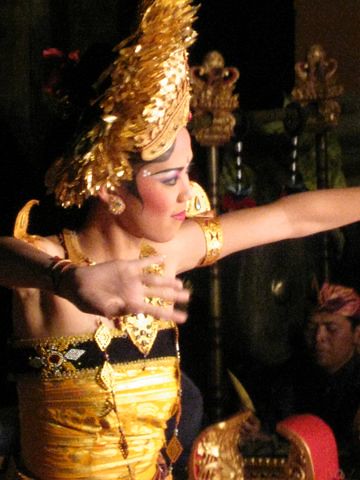
After walking around town for a bit, we had dinner at the lovely Rodo's Restaurant. Located above a fair trade textile store, the restaurant shares some of the same philosophy - vegetarian mainly (many tofu and tempe options, but also had some chicken meals) with organic, fresh local items on the menu. It ended up being the place where we spent most of our dinners and the owner went out of his way to say hello with a big smile and a few friendly words. It also happened to be quite a bit cheaper than most restaurants in town. After dinner, we decided to see one of the many traditional dances that are performed on a nightly basis. The Legong Dance is actually a collection of dances based on traditional Balinese mythical stories. All of the dances are set to the beautiful music of the gamelan, a collection of drums, symbols and a xylophone style instrument hit with tiny hammers. The dancers move with the music in precise and dedicated movements. The combination is quite beautiful. For a small clip of the dance, click here (we will upload when we have a solid Internet connection). The setting for this performance is in the Royal Palace of Ubud, a collection of older temples, one of them being the private temple for the royal family. Located right in the heart of Ubud, it's hard to miss and makes a good place marker when you might get turned around a bit. After the dance we retired to our quiet little room and prepared for the next day's trek around the countryside with the first stop: The Monkey Forest.

Day 2 - Cheeky Monkeys and a stroll around the countryside

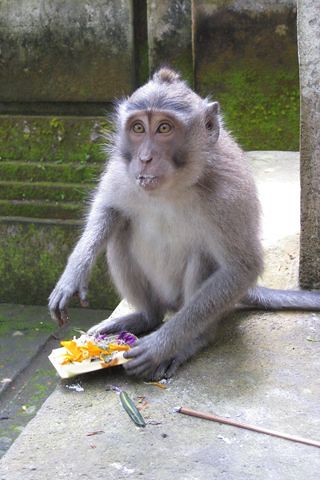
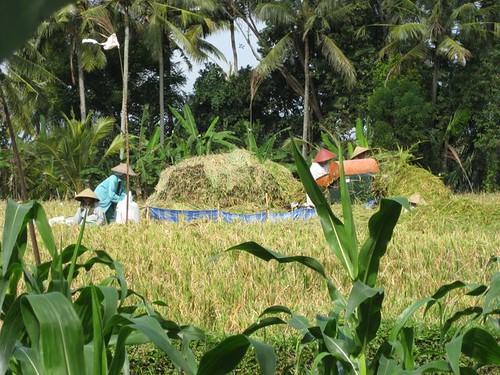
The monkey forest is known for its cheeky monkeys and cheeky they are. There are about 300 of them in this small temple complex. Although the monkeys seem to serve as a tourist attraction mainly (the signs for this place are all over south Bali) the area also serves in a religious capacity as well. In the Balinese culture, there are temples everywhere. Every family has a temple, every community within a town have a temple, and each town has at least three temples. The Monkey forest has three within it's area, with the main one being the town of Ubud's Temple of the Dead. The monkeys are sacred in their culture and are there to protect the temple from the evil spirits. Non-the-less, the monkeys are well trained to accept feeding from visitors, and the locals are happy to oblige, selling bananas at every entry point, and even some within. If you do decide to feed them, don't expect to get too far with your treats as the monkeys are keen to find them no matter what, including jumping on you if they even think you have anything for them. If you get past the first 100 meters with them, you have either run or hid them really well! After getting our fill of monkey and temple time, we made our way to the other side of the forest and began our walk through the little villages that are around the area of Ubud. The walk was about 8km total and it passed through sleepy, far less touristy towns, across rice paddies and back up the hill to Ubud. Once outside of Ubud, most of the touts for various services and goods stop. We only had one offer for a "guided" tour of some rice paddies, not quite sure if we really needed one so we declined. We did stop half way through the walk at a little nameless road side warung and had whatever she was making for only 2000rp (about 25 cents!). We have yet to actually find out what it was but it sure was tasty and consisted of peanut sauce over some kind of potato type vegetable (Cassava or tapioca we think it's called) and other mixed vegetables. On the way back to town, Tracy got in some shopping time, strolling through the various shops that line the roads. After crossing back over the river we decided to have dinner at Wary's Restaurant, a sprawling "complex" complete with a gift shop and 5 levels of dining areas, one being close to the river for an ok view (not really worth the inflated price of food in our opinion but the meal itself was pretty good and the Storm Beer, made in Bali, is actually a good beer!). Tired from walking, we went back to the room and called it an early night.

Day 3 - "I see you come and climb tree just for you! Fresh Coconut?!": The Campuan Ridge Walk

We started the next day with another walk around the area. The first walk lead to the south and this walk headed north of Ubud via a steep climb to the top of a ridge that straddles two rivers. One side of the hill is mostly undeveloped with a few rice fields and the other side looks out to the other side of the river where there are luxury hotel after luxury hotel. It was a pleasant, if not somewhat hot (no shade on top) even despite coming across a little man that yelled out as we approached "Hello! I see you coming, but you not see me! I climb to top of that tree and yell hello(he points all the way to the other side of the hill at a coconut tree at the bottom of the ravine) and cut down coconut just for you! Fresh coconut?!" We declined but you have to admire his ingenuity. He certainly has a monopoly on the fresh-coconut-in-middle-of-nowhere-after-a-hot-walk business. After another twenty minutes or so past the coconut man, you come back into the villages. After browsing the shops and catching our breath for a bit we continued our hike until we reached the main road back to Ubud. The first part of the road is a grueling, straight uphill climb. After reaching the top of the hill, there was a little Wartel (the name commonly associated to what I would call a convenience store) where we stopped and chatted with another traveler, Sterling, an expat living in Guam at the moment, while we enjoyed our rest. Continuing on the road, you pass mostly homes until you come to the decidedly more upscale area of Campuan. Filled with fine art galleries and home to supposedly one of the best restaurants in all of Asia, Mosaic (a bit expensive for our budget), it's still a nice walk checking out all the artwork on display in the shops. We stopped for lunch at Morney's Warung, certainly catering to the tourists (but then again most things around here do) with beef on the menu (Hindu's don't eat beef) in the form of burgers and ribs. The place was certainly hopping, all tourists of course, and the burger was not that great (Not sure what I was thinking ordering a beef burger in a place that does not eat beef!), but it was convenient and in Lonely Planet (the bible of travel guides) for a good burger. After lunch we continued to make our way back to Ubud where, tired and exhausted, we crashed at the room and ordered food there. Calling it a night, we decided that the next day we needed some wheels - Motorbike style!

Thursday, September 11, 2008

A beautiful sunset in Kuta but not much else...

Stats:

Destination: Kuta Beach, Bali
Number of Days there: 1
Our Best of: Beautiful sunset
One thing unexpected: Obnoxious hawkers: "Transport?"; "Take tour?"; "Marijuana?"
Times we took the: Bus: 0 Train/Subway: 0 Taxi/Car: 1
Estimated KM walked: not very many
Where we stayed: Simpang Inn - Rp 300,000 (US $33)
Favorite Restaurant: Aromas (nice little veggie place) - Tostadas - RP 45,000 (US $5) & Expresso Ice Cream - Rp 10,000 (US $1.10) The Kopi Pot (free WiFi) - Banana Pancakes with Lime & Honey - RP 18,000 (US $2)

We took a taxi to the airport (RM 23) and attempted to check in our bags for our Air Asia flight. We were informed that our bags were over the limit of 15 kilos so instead of paying the additional carriage fee of 100 RM (ridiculous) we stuffed the books & other heavy items from our checked luggage into our day packs. Problem solved and our bags weighed in just over 15 kilos (still way too heavy we know)! Our flight was uneventful and we landed in Bali! As American citizens we enjoyed the privilege of being able to pick up a visa on arrival at the airport (US $25/person). We arrived without a hotel reservation and luckily there was a travel agent situated before customs we we stopped by and he checked us into the Simpang Inn for a bargain price (yeah right) of Rp 300,000 (about $33). I'm sure he got quite a commission but it's high season and we arrived quite late so we were happy to pay it for 2 nights. We were skeptical but the Simpang Inn turned out to be quite nice with a pool, tv and bathtub (yay - all firsts for this trip)! We took a taxi into town (Rp 55,000 fixed price) and settled into our hotel. Tracy was coming down with a cold (probably from the communal tuak cup at the longhouse) so we opted to stay in and relax.

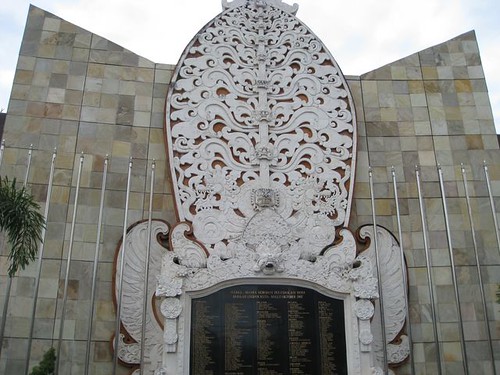
We spent the day in Kuta taking it easy, getting caught up on email, uploading pictures and browsing around town. We saw the Bali bomb memorial and spent a few hours at the beach. The main reason we wanted to come to Kuta was for the sunset and it proved to be very nice indeed! It seems like the whole town turns out for sunset and enjoys a beer on the beach, it was really kind of a nice community feeling! After sunset we just relaxed, had dinner and decided to stay in (again, that pesky cold).

Other than the beautiful sunset, Kuta didn't have much to offer. We are not really into the party or surfing scene, which is basically what the town is built for and the whole town is full of rich expats and tourists. Other than the hawkers lining the streets offering you everything under the sun, you won't find many locals here. One day was certainly enough and we decided to head to Ubud!

To see more pictures of Kuta click here.

Monday, September 1, 2008

Roughing it at the Panggil Longhouse

Stats:

Destination: Panggil Longhouse in Sarawak (Borneo)
Number of Days there: 3
Our Best of: Friendly people
One thing unexpected: The odd financial arrangement between the people setting it up and the village
Times we took the: Bus: 2, Train/Subway: 0, Taxi/Car: 2, Boat: 0
Estimated KM walked: ??? who knows how long we spent in the jungle
Where we stayed: Panggil Longhouse (package tour)
Favorite Foods: Tuak, "Iban" fries & spicy nenas (pineapple)

We decided that a trip to Sarawak wouldn't be complete without a longhouse visit. Our hotel owners for the first leg of the trip were Iban and they offered an organized tour of a longhouse for 3 days and 2 nights for 430 RM per person (about US $150). We signed up for a visit and started the trip with a 3 hour bus ride to Sri Aman. We were promptly picked up at the airport and dropped at the longhouse for lunch. First impressions:

1. Longhouse is currently being constructed.
2. Six tourists are sitting on the porch "resting". We find out that a lot of resting is involved with this tour. The Iban rest for a period of 1 hour after every meal.
3. We ask where we will stay and they say they don't know because all of the beds in the main room are taken.
4. We ask how the bathrooms were and we were treated to furtive glances (not a good sign).

Obviously our first impression wasn't a positive one but the hospitality of the people in the longhouse wore us down. It's still not an experience I'm keen to repeat but I'm glad we did it. Living in the longhouse was an eye opening experience as it was very traditional with no power and limited running water (it was piped in from the river). This meant showers using a bucket and a smaller scoop that you pour over yourself called Mandi's (icy cold river water...some would call it refreshing I guess). Did I mention that this occurs outside behind the house inside a pseudo wooden shelter with a plastic tarp for a curtain? The bathrooms, well, use your imagination. Think of an outhouse with a squat toilet and no running water. For some inexplicable reason the platform wasn't flat but tilted back so good balance was a must. In order to "flush" you had to pour a large bucket of water down the hole. Not a pleasant experience. Water consumption was cut to an all time low so usage was very minimal. For those of you wondering, yes, we had bottled water to drink. I forgot to mention where the outhouse drain was located...that would be about 50 feet from the building itself. I'm sure it's a lack of education but where did the people living there think the waste went? Hmmm...let me think, it seeps into the ground and goes back into the river. Lovely.

When we arrived at the longhouse we met everyone including our guide Kibie and his entire family. The others in the longhouse were members of his extended family which included his wife Anna, daughter Bungha & his father, the village chief. Kibie was an amazing guide and really went above and beyond to show us everything he could about the Iban way of life. Each day we trekked through the jungle looking for food (fruits, herbs & vegetables). All were collected in bamboo baskets which the women had made. At first I thought that it was for show but throughout our stay in the area we saw many people going into the forest with empty baskets and then coming out with them full of food. Back to the jungle trekking. I didn't mention that there were no paths. We made our way through the dense jungle by trekking over rocks, trees and whatever else happened to get in our way. Kibie and his friend Chlorl brought along machetes to cut our way through the jungle. The "path" included walking seemingly endless distances on logs in water, clawing our way up vines and rappelling down the mountainside using a vine for support. Jungle Jane I was not. But as they say, what doesn't kill you makes you stronger.

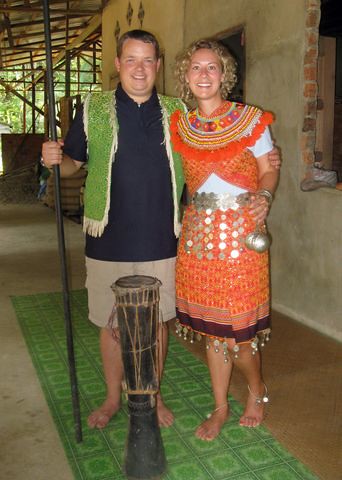
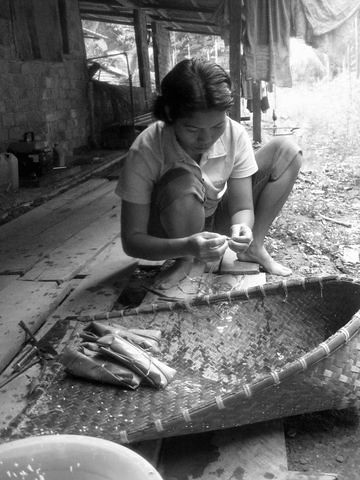
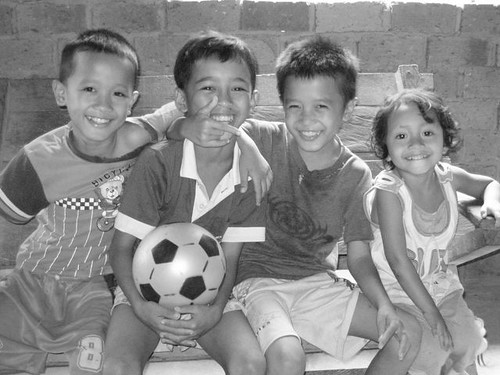
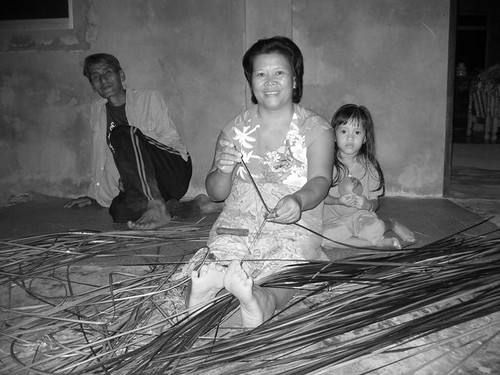
Other memorable activities included fishing in the river (yes we kept what amounted to minnows and cooked them up), seeing the preparation for bamboo cooking (the Iban cook rice and chicken in bamboo - very nice), trying on traditional Iban wedding clothing (my favorite), watching the women prepare bamboo for weaving & enjoying tuak (rice wine) with our new friends. I should mention that this particular longhouse has only been taking in tourists for about a week so there are still some kinks to work out. The positive part of this was that the locals were just as curious about us as we were about them! The locals came out each afternoon and evening and enjoyed coffee and conversation. The children were also very excited to have us around and became quite the camera hounds. This made getting to know everyone so much easier and we left really feeling quite a bit of affection for the people there. By the end of our stay there we were almost sad to leave. Almost.

The financial arrangement of the longhouse and the people arranging it is a little concerning to us. From what we could gather, of the 430rm we paid per person, the longhouse village only got a small portion of this. All the "food" that was not collected from the jungle was purchased by the B&B and in my opinion was the cheapest food in the market. The chicken that was used in nearly every dish was basically the leftover bones and skin, and aside from the bottled water, were the only things purchased by the tour operators. Other than transportation by public bus (19rm each way) and the aforementioned food arrangement, this was the only costs incurred by the operators. The rest of our experience was handled by Kibie and his amazing wife which from what we gathered, got paid for each activity and not necessarily for each person. So for example, a walk in the jungle for 3 hours - 15rm per group, trying on traditional wedding clothes - 10rm per group, take us fishing - 15rm per group, etc. During our visit, there were up to 9 people staying there at one time which would be 3,870rm collected by the tour operator of which the longhouse will probably see about 150-200rm of that. We don't have the whole story and it so we might be missing something, and all the people involved are extremely friendly so we don't want to be too critical, but we can only help but feel that someone is being taken advantage of to some degree. Just our two cents on it.

To see more pictures of the Panggil longhouse please click here.

Saturday, August 30, 2008

Monkeys in Bako

Stats:

Destination: Bako National Park in Sarawak, Malaysia
Number of Days there: 2
Our Best of: Spotting proboscis monkeys & hiking to a beautiful beach
One thing unexpected: Disgusting food (seriously, I resorted to fruit, muesli & cookies)
Times we took the: Bus: 2 Train/Subway: 0 Taxi/Car: 0 Boat: 3
Estimated KM walked: 16 km
Where we stayed: National Park - RM 40 (US $13)
Favorite Restaurant: None but the chicken satay outside the park was excellent at US $.35 per stick

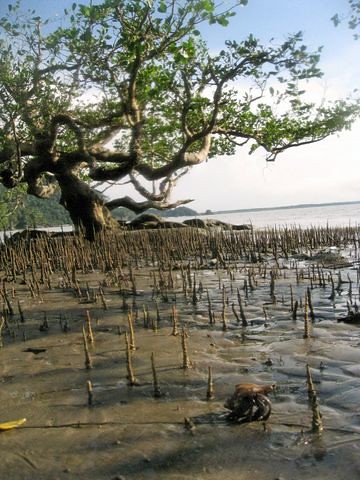
We arrived a bit late for the bus to Bako but luckily it was running behind so we jumped on and enjoyed the 45 minute bumpy ride from Kuching to Bako with the locals (bus RM 2.50 - less than US $1). We arrived and took a boat into the park (45 RM for the boat or 9 RM per person). The park is one of the few places in Sarawak where you can see all four of the main eco-systems: mangrove forest, dense forest, primary rainforest and kerangas (a plateau of rock facings and shrubs). We decided to tackle the toughest hike on our list the first day so we could relax the second and we started with the Paku Trail (1.2 KM). This trail is known for sightings of proboscis monkeys which are found only in Borneo. They are strange looking little creatures with long noses and pot bellies. We only saw a couple of them and they were quite far up in the trees so we were a bit disappointed but we figured that we might see them on other trails. The hike was a hot and sweaty affair (love that SE Asian humidity) and took about 90 minutes round trip. It ended at a secluded little beach. I wished we could have stayed longer but we had other trails to conquer! Our next hike was the Lintang Trail (5.25 km). It's a loop trail that Lonely Planet recommends as it covers a good area of the park and provides an overview of the vegetation in the area including the sandstone kerangas. It took 3 1/2 hours to cover and the initial 40 minutes of the hike was extremely steep. After 90 minutes the trail leveled off and we hit the kerangas The lack of shade on the kerangas made the hike intensely hot. Overall it was our least favorite hike in Bako, we didn't see any wildlife and the vegetation wasn't very different from the other hikes we completed. We finished the day with the Delima Trail (1 km) which was an easy walk through the mangroves. We both found it very interesting as the tide was out so it was neat to see the full mangrove along with the existing sealife (crabs, snails, etc). On our way back we also heard the probosis monkeys crashing through the trees. Later that night we took a stroll on the beach at sunset. We saw 3 bearded pigs eating at the edge of the beach & the forest. There is only one option for dining at Bako and they do a la cart buffet style where you pick up the items out of dishes and are charged per item. Not only were the prices inflated, but the food was down right putrid. Even the vegetable dishes were virtually inedible. Luckily they had some oranges for sale so after wasting our money on "dinner" we settled for the oranges. They also have a board you can order from, so perhaps that is better and we suggest you take that route if you go.

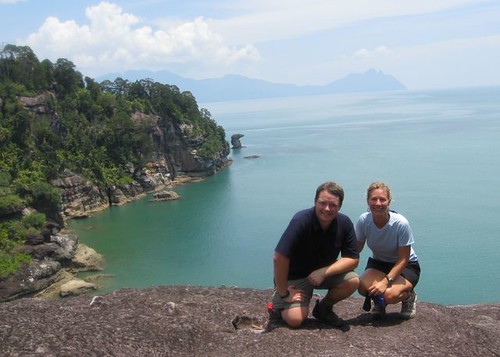
We decided to take it easy our second day and spend a bit of time at the beach. We spent 2 hours (2.5-3 km) hiking to Telok Pandan Kecil with a side trip to Telok Pandan Besar. The latter is a cliff side overlook and the former includes the trail down to a secluded beach. After our hike we rewarded ourselves with a bit of beach time and a swim in the warm water! We opted to take a boat back to our lodging to shower and get ready to head back to Kuching. While we were hanging out at the lodge we saw several macaque monkeys which were trying to steal food from the restaurant (very naughty indeed) as well as another bearded pig! On our walk to the jetty we came across another couple of macaques and finally we came close to the proboscis monkeys (YEA!)! We ended up seeing more wildlife in the last hour of our stay than we did during the first full day!


To see more pictures of Bako National Park in Borneo click here.

Thursday, August 28, 2008

Meow: Kuching the cat city is calling

Stats:

Destination: Kuching in Sarawak, Malaysia (Borneo)
Number of Days there: 4 (starting point for Longhouse visit and Bako National Park)
Our Best of: Kuching Food Festival, Sunday Market, eating Laksa at a local dive
One thing unexpected: The contrast of the Malay village to Kuching's main tourist area (separated by a river, but seemingly miles away from one another)
Times we took the: Bus: 0, Train/Subway: 0, Taxi/Car: 3, Boat: 2
Estimated KM walked: 16
Where we stayed: Borneo Bed & Breakfast - RM 45 (US $15) Friendly Iban ran joint
Favorite Restaurant: Kuching Food Festival - probably a hundred food stalls with awesome food at bargain prices Pineapple Fried Rice (RM 2.50 - less than US $1), Mango Fish (RM 3.50 - just over US $1), Pau (RM 1.10 - US $.35) & Roti (RM 1 - US $.30)

Kuching is the capital of Sarawak, Malaysia. Most people still refer to the region as Borneo which is actually the name of the island that is home to the Malaysian states of Sarawak and Sabah and the Indonesian state of Kalimantan. The state is comprised of mostly Iban or Orang Asli (one of the two main tribes and Christian in religion) followed by Malay from the mainland and then Indonesians(legal and illegal). In talking with the Iban family that runs the nice B & B we stayed in, you get the sense that they don't care for the predominately Muslim Malay or the Indonesians that apparently come across the border and are up to no good. For this regions standards, Malaysia is far better off than the much poorer Indonesians. The main draw of Sarawak are all the national parks that are set up along with visits to to the longhouses. We chose Kuching for our base to explore the area so our time spent here is divided by visits to Bako and the Longhouse (both on separate postings).

After arriving into Kutching late at night, we were greeted at the door of the B&B by May and Bidas, the owners. After sitting our bags down in our cozy little room (hot shower/attached bath/A/C for 45rm $15us) we returned to the outdoor patio where we were promptly handed two beers. The jovial owners sat and talked about the area, what to see, where to go, and of course, their longhouse visits. The hotel itself is very simple, but the hospitality that was given more than made up for any inconvenience. The only complaint of the hotel was its proximity to a bar that thumped out an entire Whitney Houston CD on a loop (yes, we can't make this stuff up!) until around midnight and then they turned it off or down. Otherwise, nice place to stay and the price is right.

We started our first day in Kutching by promptly getting lost, don't let the small size of the town fool you - it's easy to get turned around. After getting our bearings back in line and retracing our steps a little, we made our way to the visitor information center, which is one of the few places you can book the accommodations for the only place to stay in Bako National Park. Luckily for us, someone had canceled their stay for the next night and so we jumped on that taking the last room available. Otherwise it would have been 6 days later for a room. After getting that business taken care of we had just enough time to duck into a Chinese restaurant around the corner for lunch before catching the afternoon shuttle to Semmengoh Orangutan rehabilitation center. After asking specifically for no disgusting fish balls and getting them anyways (they taste as bad as they smell) in our soupy broth of noodles, we have both decided to avoid Chinese food for a while. American readers might find this a little strange, but trust us, Chinese food here is nothing like the buffets back home. From what we pass in most markets and street corners, it's fish balls, boiled chicken bones that you have to pick through, and most things come topped with this "delicious" shrimp paste that has an overpowering rotting fish taste, along with some variety of dried fish (anchovies are VERY popular here). If you enjoy the taste of rotting or dried fish, then we apologize and eat up, I promise we will leave some for you! This now being the second posting in a row on our disgust for Chinese food and moreover the aroma that wafts through every street you turn down we will now try and let this one be.

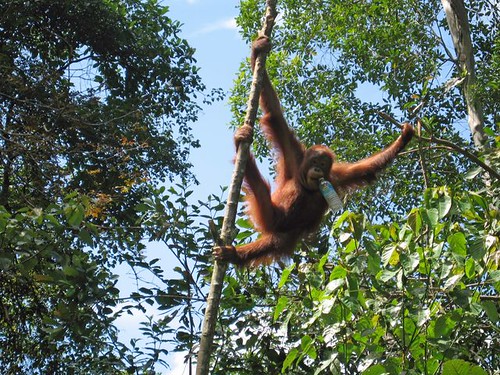
The saving grace of any meal that we come across as bad is the ice cream that is basically sold on every street corner in the little convenience stores. After grabbing a couple of cones for the road we jump on the van bound for the orangutan center. Since there are no public buses that go directly to the reserve (you can find a bus heading south, get off at the nearby town, and walk about 30 minutes to the entrance for 3rm one way so we have been told) we opted for the round trip 25rm ($8US) per person that departs from town and coincides with the feeding times at the park. The park is home to around 20 Orangutans that have either been rescued or born in captivity. Despite the fact that they feed them, they are considered wild and free to roam about in the forest. From the constant clearing of land to make way for planting crops, their natural habitat is quickly disappearing making them an endangered species. As it stands now, Borneo and Sumatra in Indonesia are the only two places in the world that they are found wild and the numbers of wild orangutans are quickly dwindling. The orangutan is an amazing creature, and quite similar to humans in a lot of regards. Being 97% closely related to humans they have a lot of the same characteristics of humans. It was quite the experience to be up close and personal with a few of them. They would often times be right in the walking path and we would have to stop and wait for them to move out of the way.

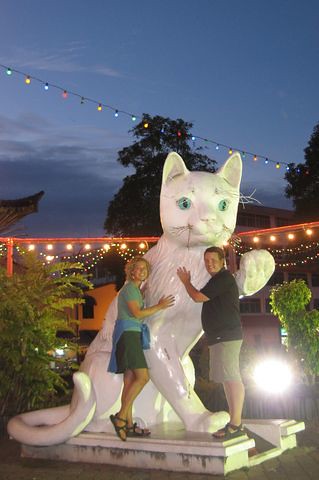
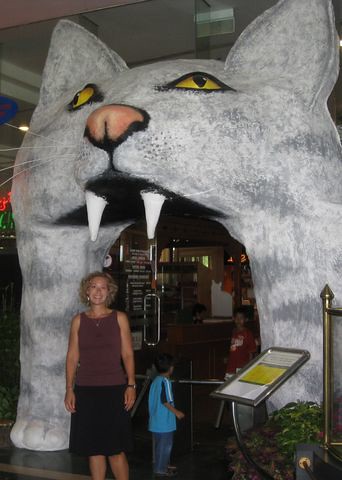
After returning to Kutching, we had heard of a little street fair that was going on across town to celebrate Merdeka (Independence Day for Sarawak) so we decided to head out there for a bite to eat. Along the way we passed all three of the main cat statues (one is a family of cats, the other is a tall tower with a cat perched on each corner, and the last is the Great Cat of Kutching). Kutching literally translates to cat in Malay and the city has embraced that fact. All the shops have wood carvings of cats for sale, there are several statues randomly placed throughout town and naturally, a cat museum which we visited later. If you are looking for a massive statue, the Great Cat of Kutching, despite its name, stands only about 9-10 feet high. After passing around the traffic circle and walking another couple of blocks, we find the fair.

The fair ended up being our favorite part of Kutching. Sadly, it was only lasting for 3 weeks so you have to be here at the right time to visit. Imagine that QVC, or home shopping network, was an actual place and each booth represented a different segment and you come close to the actual fair part. Each booth had their respective products out for show and many had demonstrations of how they worked complete with microphone and loud speakers. From woks that don't stick to mops that get up the toughest of grime the only thing this place was missing was Ron Popel himself. After laughing a little at the spectacle, we made our way through the booths, past the live performance stage (had to be karaoke night, another popular past time here) we came across our little oasis. Stall after stall, cuisine after cuisine (of course the Chinese fish balls had to make an appearance) we strolled though picking up little things here and there. Since the average cost of any item you chose was less than 3rm (less than $1US) with some 1 rm it was guilt free pleasure. We even found a Chinese food we liked - Pao (basically steamed bread dough stuffed with various fillings and served warm, Tracy prefers the coconut or kelapa in Malay; and I think they even have fish ball flavor, but we dared not ask!) so perhaps not all hope is lost for Chinese food...yet. After stuffing ourselves, we took a stroll through the nice little park they had set up, complete with water effects - waterfalls and fountains. One thing of note on public transportation in Kutching - don't expect it after dark unless it's a taxi in the middle of the tourist district. We waited for 20 minutes to no avail to catch one back into town and finally gave up and walked back to the hotel.

The next two days were spent in Bako. For more info, read the next posting.

While we were in Bako we met Hong & Harold (from CA) and they invited us to dinner at the Top Spot Food Court in Kuching. Amongst mostly locals we enjoyed spicy chili crab, grilled prawns & Tiger beer (yummy)! It was a bit over our backpacker budget (around $13-$15 per person with beer) but it was a nice splurge after two days of hiking!

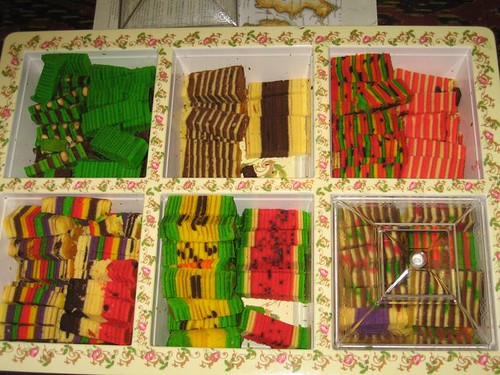
After a lazy morning recouping from the hiking in Bako, we made our way to the Sarakraf Craft Center on the south side of town. We were expecting lots of artists making various items, but instead found two artists, one making a traditional batik, used for weddings, and the other making sarongs. Not sure if it was just the day we visited, but we were virtually the only ones there. Tracy decided to take the little class that was offered on doing bead work (30rm and you get to keep what you make). About an hour later, she had finished a little bracelet. After the class, we walked down to a great little Indian restaurant Tok Janggut Cafe. Jason got his first haircut abroad at a little salon nearby after lunch and we headed back into town to the museums. The museums, from what we saw of them, were fairly basic. The top floor of the Entomology Museum was interesting which covered in detail the various tribes of the region and their customs over the years - from the headhunting days to present day living. We only saw a couple of rooms of the Islamic museum before they kicked us out at closing time but the ones we saw were interesting. That night we took the little boat (.50rm each way) across the river to the Malay village on the other side of the river. It was surprisingly a lot different than the touristy and mostly Iban side of town. The bars were replaced with mosques and we received some odd looks from the locals. Despite the odd vibe, we still enjoyed our meal from one of the little stands on the street which had tables right on the waterfront. We also stumbled across the home of the little cakes that are sold up and down the main bazaar in town - kek lapiz. The little bakery was humming with locals buying lots of these colorful and tasty little treats. While there are too many flavors to name here, and most we don't even know the flavors to begin with, we settled on what they call a Swiss Roll which was delicious. We caught the little ferry back across the water and decided to call it an early night considering we had an early start to the next morning.

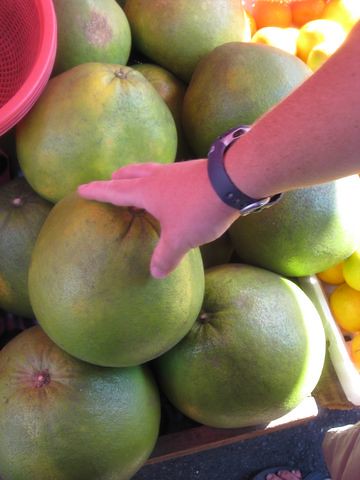
The day earlier, we had asked May where a good place in town to find Laksa might be. Laksa is another Chinese food that is a breakfast item consisting of a coconut chicken porridge (soup broth), prawns, and noodles. Instead of just telling us where it was, she told us that her son would take us there in the morning and then drop us off where ever we were going for the day. That in itself was a friendly gesture, but when her son not only took us there, but paid for it as well, that was something special. The Laksa did not disappoint - full of flavor and just the right consistency, it was certainly one of the best meals we have had so far (score another good point for the Chinese, they are making a comeback!). After devouring the delicious meal, we were dropped off at the Sunday market. The place was packed with stands selling huge pummelos (large grapefruits), plants and flowers, all the fresh fish you could ever want, to even pet dogs and fish (not for eating...at least we think). There was even a stand that sold old magazines with the covers ripped off and DVD's for 1rm each, mostly B movies and American wrestling (every Wrestlemania title) seems to be huge here as well. Of course there were plenty of options for food as well. We sampled the coconut juice which Tracy thought was the best so far and various pastries - mostly good, but the one Chinese whispy fingers (some sort of fried dough) was nasty (minus 1 for the Chinese). We even came across the "snail shells" for momma Karen. After lingering in the market for most of the morning, we made our way to the bus stop to take it up to the Cat Museum. Quite a ways up on the north side of town, the Cat Museum sits on top of a huge hill and overlooks the city below. The Museum building has an interesting architecture style and was much more interesting than the museum itself. Inside, there is everything you wanted to know about the history of cats from Egyptian times to "present" day (I think the museum needs a little updating as it appears present day really means sometime in the mid 80's.) Not really worth the effort in our opinions but when do you ever get a chance to see a museum completely dedicated to felines? After waiting for what seemed like an eternity for the bus to come by, we were starving but didn't feel like walking all the way out to the fair given the time of night and our early departure time to the longhouse, so we asked where an Indian restaurant might be and were told their would be one just off the waterfront. After walking down basically desolate roads where NOTHING was open (this town really shuts down after dark) we settled on a little Italian joint in the touristy part of town. Not our style, but it was not too bad considering the other options that were readily nearby were Pizza Hut, McDonalds and the ubiquitous KFC (2 within two blocks). The bucket of chicken rises higher than any cat statue they put up!

The next three days are spent at the Panggil Longhouse. See the posting for more info.

After three days of eating basically chicken bones in broth served with weeds and rice, we were ready for some real food and we could not think of any place finer than the festival for dinner! We hightailed it over there and our eyes became much larger than our stomachs ordering two portions instead of the usual one for the two of us. We gorged until it was painful, but it was worth it and really only added up to about $13US! Later that night we went to book the plane ticket to Kota Kinabalu, Sabah for the next day. The cheap ticket had all of the sudden doubled in price, but the flight to Bali was back on the board and a normal fare on Air Asia (total of US$100 per person) so we booked it instead with plans to go to Sabah after Indonesia now.

We spent the next day basically catching up on reading about Bali, since we really thought we would be there in another 3 weeks, picking up some last minute souvenirs, and trying to book a hotel in Kuta for the night, to no avail.

We run out of time calling places for a room, so we board the plane heading to Bali with no room booked yet again. One day we will get with it, but until that day comes, off we go to Bali for some more adventures!

To see more pictures from Kuching click here.

Thursday, August 21, 2008

$500 fine if you do not read this posting: The fine city of Singapore

Stats:

Destination: Singapore, both city and state Number of Days there: 3
Our Best of: Admiring how orderly and efficient everything here works, Night Safari
One thing unexpected: The shopping malls on EVERY corner, you have to walk through one to get to where you are going in a lot of cases.
Times we took the: Bus: 2 Train/Subway: 8 Taxi/Car: 0
Estimated KM walked: 15-20 km (far enough to get blisters!) Times we were “lost”: 0
Where we stayed: Backpackers Cozy Corner S$50
Favorite Restaurants: The two main Hawker centers - Lau Pa Sat and Maxwell Road Food Center
Total "Fines" accumulated had we actually been caught doing them: $1100 (jaywalking carries a $100 fine)

Day 1: Chinese food scented hostels, Wheel of Food, one quirky riverfront

We arrived mid morning on the night bus from Perhentian and headed over to the hotel we had in mind, the New Seven Storey. Unfortunately, it was full and they suggested the Cozy Backpackers Corner around the corner from them. While it was adequate, it was by no means up to standard; especially considering that it now has the dubious distinction of not only being our most expensive hotel, but also the dirtiest. Add on the fact that it sits right above a Chinese restaurant that shares that same wonderful aroma with your clothes and we were ready to leave fairly quickly. It's one saving grace was the friendly lady behind the desk that was always helpful with answering our questions. Since we were only staying two nights, it was not really worth it to switch so we settled, dropped off our bags, and took to the streets.

Singapore sits at the tip of mainland Asia making it a significant trade port for the region. Bustling business centers of both local and foreign companies give it a lively, and yet, squeaky clean image. With every road clearly marked and a well laid out subway and bus system this is one of the easiest places to get around. We decided to take a stroll through Little India first. Much like KL, Singapore has become a melting pot of cultures, religions and languages. While English seems to be the more prominent language, Cantonese (Chinese) is a close, if not more widely understood, language of the city. The English spoken here is difficult to understand and really seems to be a foreign language onto itself. Little India has the usual mix of temples and shops. Being a holiday weekend (their independence day from Great Britain) the streets were filled with locals shopping, quite the past time here (but more on that later), the devotees hitting the temples and even a little remote control car racing in the park. Showing the true mixture of the city, right next to a Hindu Temple was a Mosque, which was around the corner from a Chinese Buddhist temple. After strolling though and hitting a few of the temples, we hopped on the subway and made our way down to the business center.

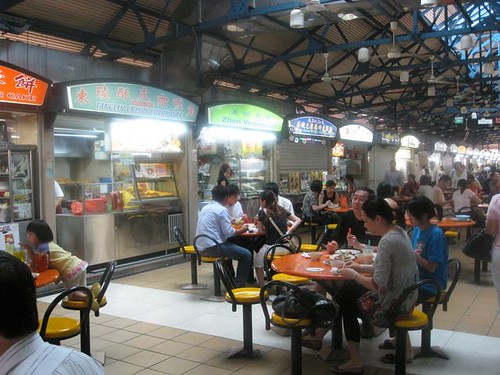
As we walked toward one of the hawker centers, Lau Pa Sat which straddles the Business District and Chinatown, we started to wonder if we were even in the right place. The bustling streets from earlier were replaced with towering buildings and high rises, construction zones laying silent and not a soul in sight. Just as we thought we had made a wrong turn somewhere, right in front of us was our first food destination - hawker center Lau Pa Sat. Singapore, in an effort to keep the streets clean and tidy, basically has outlawed street vendors except for in designated areas. It's an interesting concept, but it does make it easier to choose your meal. Like spokes on a wheel, the center sprawls out into eight lanes, all lined with food vendors trying to get you to be their next customer. At the hub of the wheel, you find most of the beverage and dessert vendors. At nights, one of the side streets also comes to life with satay (grilled meats over a charcoal flame) masters firing up their grills and adding into the fun. We settled on the stall that sold vegetarian Indian food (quickly becoming our favorite fare in the region) at the name-your-price cost. It's an interesting concept and one that I hope catches on, you pay what you feel is fair. Aside from the interesting concept, it also was delicious with a friendly server that just kept smiling when we asked what he felt was fair to pay.

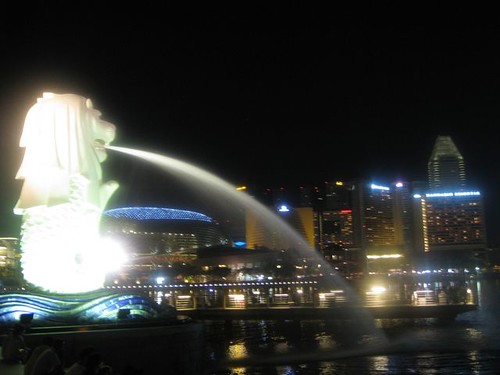
After dinner we made our way down to the riverfront. While it's not exactly the most picturesque riverfront in the world, they seem to be trying to reinvest in it and make it world class. Cente

red in between two large construction zones was the newly constructed Esplanade Center (looks like two huge durians and houses the opera and the theater) and a Merlion (yep a mermaid with a lion's head) fountain. Both structures just add to the quirkiness that is Singapore.

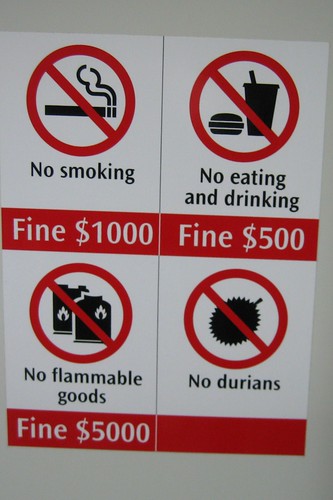
Ah yes, the weird side of Singapore. To keep that clean image, the country has a fine for just about anything that they deem offensive. It's $100 for jaywalking, $100 for smoking anywhere in public ($1000 on the subways) $500 for eating or drinking on public transport and just bringing that durian (one stinky fruit that they sell in separate markets away from other foods) on the subway will cost you $500(unless I am reading the sign wrong)! In addition to all the wonderful fines, they also like to put the fear of god into the public. Dengue fever apparently is caused by not emptying out your bamboo pole holders (whatever that is and only the bamboo variety will cause such things?!) At every subway stop, a public service video plays on a loop letting you know what to do if someone looks suspicious or leaves a bag behind on large TV screens. It's $5000 if you accidentally hit the panic button, which is not that hard to hit. That is assuming that the average Singaporean would even notice. It's a city that seems to be obsessed with electronics. There are entire shopping malls dedicated to computers and gaming and almost everyone on the subway has at least the cell phone out texting someone or some form of handheld game (PSP, DS, Gameboy, etc.) or in some cases, both at the same time. I must admit that being a occasional gamer myself and my love of electronics I could move right in.

Moving along, we ended the night with the Fountain of Wealth, the world's largest fountain. It's not quite how I imagined it, one huge steel circle and in the center lies basically a water main that fans out the water. Certainly not the most picturesque fountain we have seen but impressive non-the-less. As we were walking around it we noticed that in the middle of the water, a cartoon was being shown right on the water. Adding to the ambiance was the nightly DJ cranking out the dedications, ala Casey Casum and, yep, another shopping mall attached. After the cartoon was done playing, the main blast of water shuts off and turns into several little fountains right in the center where people walk around it three times for good luck. We took our turn walking around the fountain while jamming out to Bon Jovi's "Living on a Prayer" and decided we had had enough of Singapore for one day and returned to the Hotel.

Day 2: Chinatown Pt. 1, The Zoo, The Night Safari

We started off our second day in Singapore by heading over to Chinatown to try and catch one of the most famous wet markets in the world, Kreta Ayer, named after the street it's on. After walking the length of Kreta Ayer and not seeing one thing that resembled a market, we stopped and asked someone. They pointed to a building around the corner that ended up being Maxwell's Food Center, one other hawker food center in town. Not quite ready for lunch we wandered around a little more in search of the infamous wet market. After finally finding it, in the basement of a...shopping mall...it was a little too quiet to be a wet market. That's when we realized that because of the holiday, hardly any of the stalls were open. We decided to just come

back in the morning and head back to Maxwell's for lunch. The layout of Maxwell's was a little more straightforward than Lau Pa Sat; 3 straight rows that stretched down the block. We noticed that two stalls in particular had lines that stretched out into the walking spaces, one was for "porridge" noodles in a soupy broth with several choices of meat; and the other for "fish head soup" which I think you can figure out the ingredients of that dish. We decided to give the porridge a try and "Q'ed" up (stood in line). After 15 minutes had passed and they had served only one customer, we decided that the porridge would have to wait and took our second choice, the little Thai stand at the other end of the center. Bellies full of tasty pad thai (you can't go wrong with this dish), we jumped back on the subway and headed for the zoo.

The Singapore Zoo is considered one of the best in the world and since we really didn't want to shop, and the other "main" attraction in Singapore is a fake island (metal trees, piped in music, etc.)called Sentosa, we opted to spend the time at the zoo in the afternoon and then the Night Safari next door at night. The zoo is huge and is home to a white tiger, family of orangutans (that pose for pictures at set times for $5), the infamous Komodo Dragons, and all your other basic zoo animals. While it's certainly not the worst way to spend an afternoon, it's more or less like any other zoo - caged and staged.

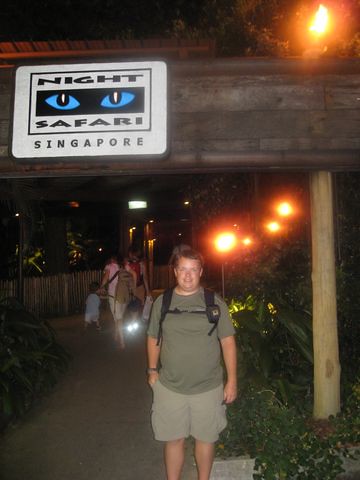
The Night Safari on the other hand, was, in our opinion, worth the time. While it may seem like it's the zoo, it's actually an entirely different section with it's own animals. There are three trails you can walk down passing by anything from a cute little family of river otters that squeak in
fear when they see you, to bat-like flying foxes (they are actually quite large) to larger animals like tigers. Since most of the animals are nocturnal they were much more active than what you usually see in a zoo. In addition to the walks, you can also ride a tram that takes you around the park and to areas that are not "safe" to walk around in. The guided commentary and cool breezes were a nice break in between the walking trails. They also have a show, which is cute and slightly entertaining, but the other people in the audience that cannot seem to understand the concept of "no flash photography" or "please do not call the animals, you are delaying the show" got a little old. After just making it onto the last bus to the last train back into town, we headed back to the hotel to rest our now blistered and tired feet for the night.

Day 3: Chinatown Pt.2, Asian

Cultural Museum, back to Malaysia

We decided that we would give the wet market another shot and this time we were not disappointed. What was quiet the day before, was now bustling with tons and tons of fish, chicken and pork for sale. There was even a row of more exotic items for sale like turtles and frogs. Being Singapore, this wet market was a little more clean and "upscale" than others we have been to. No dark alley ways here and it was very clean. Sadly, it does appear that this form of shopping for meats and vegetables is coming to an end. There were few people actually shopping, and the ones that were were significantly older than your average consumer. With supermarkets becoming more and more popular, I wonder how much longer these type of venues will be around. Only time can answer that, but for now, it's an experience that we rarely miss when given the opportunity.

After hitting the wet market, we returned to Lau Pa Sat for one last lunch at the same vegetarian Indian stall and walked over to the Asian Cultural Museum. Sitting on the banks of the Singapore River where Sir Raffles (founder of modern day Singapore) first landed is the Asian Cultural Museum. The museum not only covers the history of Singapore itself, but the entire region as a whole. It covers the spread of religions in the region as well as all the kingdoms, arts, and European influences over the years. It was very educational and we wished that we had carved out more time to explore it in depth. They also had a special exhibit on Vietnam which went into depth on the tribes that became kingdoms and eventually to the communist society it is today.

Leaving the museum behind, we grabbed our bags and headed for the bus station. Since the flights from Johor Bharu (Malaysia and sister city to Singapore) are quite a bit cheaper than the flights from Singapore to Kuching, we had to clear immigration back into Malaysia. It's not that
difficult to do, but one word of caution - do NOT follow the signs that say "This way to Buses for Johor Bharu" For whatever reason, there are no less than 6 signs that hang down and say that, but if you do, apparently you end up walking across the bridge instead of actually taking the
bus to Johor Bharu. Instead, when you come down the escalator after clearing Singapore immigrations, turn to your right and there the buses will be. Go figure. After clearing immigration and customs for Malaysia, we jumped in a taxi with a fellow traveler and made our way to the airport in Johor Bharu, which was a lot nicer than we had imagined.

We boarded the plane problem free and landed safely in our next stop: Kutching, Sarawak.

For more pictures of Singapore please click here.



Saturday, August 9, 2008

You're on Island time now: Perhentian style

Stats:

Destination: Perhentian Islands (Kecil, aka. "the little island") Number of Days there: 7

Our Best of: Dive Temple of the Sea, Grab a Shake from the Pit Stop Cafe and soak up the sunshine

One thing unexpected: Generosity of fellow travelers and complete strangers

Times we took the: Bus: 0 Train/Subway: 0 Taxi/Car: 0 It's an island without roads!

Estimated KM walked: maybe 2 km and that's a stretch Times we were “lost”: 0

Where we stayed: Panorama Inn - 85 RM (US $29 including RM 15 for dinner)

Favorite Restaurants: Pit Stop Cafe - Awesome mango shakes - RM 5 (US $1.75) & Snickers shakes - RM 6 (US $2); Panorama - Squid Tempura - RM 7 (US $2.35) & Tandoori Squid - RM 15 (US $5)

Dives: Temple of the Sea (our favorite!), T3, Seabell, D'Lagoon, Tangung Basi, Sugarwreck

Day 1: Cramped Minivan, Crazy Boatman, No room for you!

After getting our taste of the cooler hillside, we opted to head over to the island of Perhentian Kecil, aka. the Little Island, for some fun in the sun and water. The Perhentian Islands are located just off the Northeastern coast of Malaysia and are known for crystal clear water, white sandy beaches, and great coral reefs just off their shores. Defying the natural law of physics, our minivan cramped ten people plus our luggage (mostly all backpacks) into the space that really should hold 6-7 comfortably. To top off the cramped conditions, the roads are not straight and the drivers seem to think the roads are their personal racetracks. They weave in and out of lanes as they wind around corners. Seven long hours after departure we arrive at the boat dock jarred and ready to at least stretch our legs. The boat drivers, much like their counterparts on land, have no regard for the passengers comfort. Crammed shoulder to shoulder with our feet resting on our bags off we go on the boat ride from hell. Now I understand what really people really mean when they say they may never want to leave, they fear the return boat ride! It almost seemed the driver was intentionally hitting every swell on the ocean sending the passengers on board up and down from their wooden and uncovered seats. After an hour of unnerving jarring we arrived at our destination of Long Beach, Perhentian Kecil and thought we could find a place to stay, book a dive or two, and take it easy for the rest of the night. Little did we know at the time that the island had other plans. First hotel on our list to check out - full, second one - full, third - a head shake before we even asked. Tired and exhausted, we park the bags and Jason along with a fellow traveler, Dorian, go out in search of a room somewhere, anywhere. Between the two of them they check all the hotels and there is not a room to be found anywhere on Long Beach. Finally, after picking up a calling card we found three dorm beds available on the other side of the island. There were four of us searching for a place to stay so we figured we would beg the manager to let us stay for the night and to squeeze in one additional person. Of course since the only open place was across the island and the only form of transport being by boat the "friendly" boat taxi man quoted us 20 RM per person, that's the night rate after all - that's 80RM (US $28) for a 10 minute boat ride in case you were wondering. Outrageous! The dorm room was only going to be 15 RM per person. Luckily we were saved from trekking across the island to spend the night in a dorm by a friendly couple from France! Thank you Cristina & Vincent! They kindly offered us an extra mattress in their room (hidden under their bed) and we slept on their porch for the night. The next morning we got up and found someone checking out at the Panorama so we moved in there for the next week. We spent the first day relaxing on the beach which we felt was very deserved after our long trip! We looked into a couple of dive shops and settled on Seadragon Divers (highly recommended).

Days 3-5: Dive, have a shake, lay on the beach, have dinner

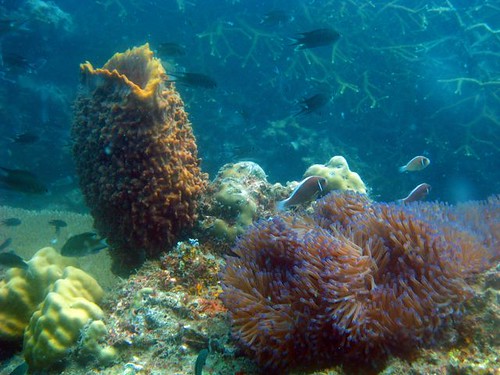
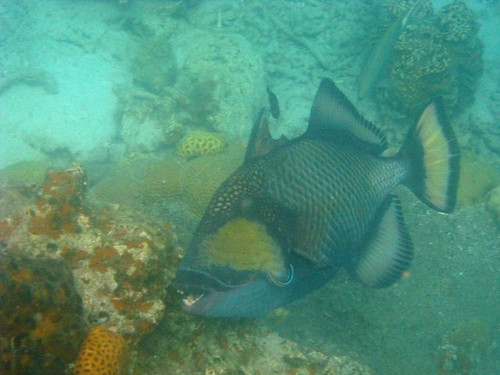
The next couple of days, after the crazy travel day, we ended up changing our opinion of the island. All the rude and unfriendly people from the day before grew on us as did the island and we ended up really enjoying our time here. After the first day of doing absolutely nothing we spent the next three days doing pretty much the same exact thing. Wake up and dive, go to the Pit Stop Cafe for the best shakes on the island, not to mention "reasonable" prices for lunch (3-6 RM per dish) and then lay out on the beach for the rest of the afternoon. Since our hotel included a free dinner, it made our dinner location decision an easy choice. The most popular meal on the island, and probably the best, had to be the nightly BBQs that were pretty much offered at every restaurant along with a nightly movie. Fresh grilled fish, chicken and squid (yum!) filled the night air with a wonderful aroma. The movie thing is a bit quirky if nothing else. All the hotels placed the movie of the night on their boards. With titles like Run Fat Boy Run, Over Her Dead Body, After the Sunset and The Love Guru they seemed to be more of a draw for the locals than anything else. On an island powered by generators running all the time and no roads, the folks living there can't exactly go to the local movie theater or mall for that matter. Aside from eating all day, we did manage to work in a one tank dive each day. At 70M ($23US) per dive including all equipment, it was a great bargain. Our favorite dive site was Temple of the Sea, an interesting rock formation starting at around 22 meters below the sea and spiraling up to an exposed surface area of only about 3 meters above the sea and around 5-10 meters wide at the top. The natural topography makes for an easy and enjoyable dive as you start at the bottom and just circle around spiraling up. Even the 5 meter safety stop is enjoyable with schools of fish and the occasional turtle or two hovering in that same area. Aside from temple, we also did D'lagoon, T3 and Tanjung Basi. Long Beach is nestled in a little cove that is filled with pristine crystal clear waters and fringed on either side with rock cliffs and dense jungles. At the northern edge of the bay, there is plenty of snorkeling to be had just a few meters from shore where we saw quite a bit of coral and was home to a large triggerfish (check out those teeth).
Day 6 and 7: Wreck dive certification, a scary moment, it's island time man, we wave good bye

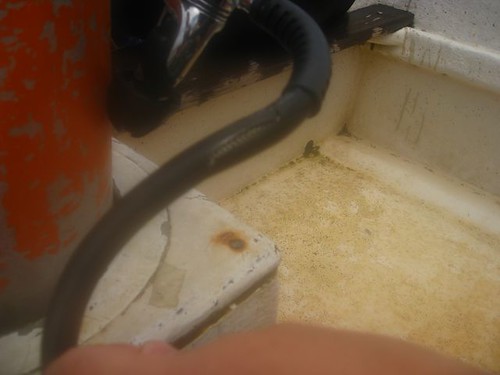
Since we were enjoying our time here, we extended our stay on the island an extra couple of days and decided to go ahead and take the first of five required advance dive courses - Wreck Dive Certification. Sugar Wreck refers to a barge loaded with sugar that was in tow to the mainland, took on water and went down in only 20 meters of water. It's only seven years old so a relatively young site so the ship itself is in good condition and in such shallow waters for wreck dives that it is considered an easy dive to learn with good visibility. After dropping down 5 meters, you are right on top of it! We dropped down past the propeller on the back side and the plan was to swim from one end to the other weaving into one of the cargo holds, back out, and onto the top to explore a bit. Just as we were approaching the middle of the ship, Jason heard a humming noise that sounded like a boat on the surface and didn't think much of it until the humming turned into a loud bang. As soon as the bang went off he felt something hit him in the back of the head. Thinking that something had fallen onto his head or he had accidentally swam into a part of the ship, he spun around to look up and saw nothing but a lot of bubbles flying to the surface. He then checked his air pressure gauge and then realized that it was dropping fast in pressure. Something was definitely wrong, but all he could hear was the sound of air escaping out of the tank. The dive master, Rob, came swimming over with his second stage regulator in hand and we prepared for an emergency assent. Only after getting to the surface did we realize that the low pressure hose had burst at 20 meters, or 60 feet below the surface! I guess it's a good thing you go through all those emergency procedures for times just like this. It really does happen so fast that you really don't panic as long as you remember what to do. Luckily for us, aside from the obvious surviving to tell the tell, Jason was just down long enough to qualify as a completed wreck dive so that one is on the books!
The last day in the Perhentians we decided to take it easy and rest on the beac. We stopped by the Pit Stop for one last daily ration of shakes and fried rice and noodles and we hit up the "free" WIFI (you have to buy food at Rumours Restaurant at Moshin Hotel) to make a few Skype calls back home. While on the island we came across another inspiring couple traveling the world for what seems like infinity, or at least as long as they can. We were simply amazed that not only had they been traveling for over SIX years, but they also had in tow two beautiful twin girls for the past year of the journey. They decided to rent out their flat in Bangkok and live off that by bicycling around the world as long as a visa lasts in each country. To check out their journey, visit www.pedalrevolution.net.
Transit by bus to long distance locations like were we are going next, Singapore, can be arranged at the Lazy Bouys shop (apparently the only place on the island) by the interesting shop owner. The first day we went by at 11:30 am and it was closed. The next time we went by, the bus office was closed, "come back tomorrow". "What time do you open in the morning?" reply: "When I wake up." The third time, "Bus office is out to lunch, come back at 3". Fourth visit: "Bus is full...wait...let me call first...where you go again?" After a few minutes on the phone, "oh ok, no problem, tomorrow right?" We shake our head yes and he replies "let me call again." Another minute on the phone, he turns and says "ok, 140 RM." It was just another interaction that at first was frustrating but in the end the guy redeemed himself by showing us his true side. He was really proud of his music, typically American rap mixed with Techno that he blared throughout the stop and offered to show us the file sharing program he used, www.deezer.com, which has albums and albums that you can stream online. He asked us to type in a band, any band, and I of course typed in Pink Floyd which he replied, "oh yes, my favorite!" Our feelings of everyone on the island are all pretty much the same, they have a hard outer shell, but it's fairly thin and given a minute to get to know them they are all warm and genuinely nice. We were really reluctant to be leaving (in small part for the impending boat ride from Hell pt. 2), but the rest of the world is calling and the islands aren't exactly the cheapest place to settle in for an extended stay.

After giving the island one last good look the owner of the Pit Stop took us by boat to the speedboat and we started the next leg of our journey. We made about twenty stops before setting off, each time piling in more and more people as well as luggage until we were sufficiently miserable. Then the driver cranked it wide open running back to the mainland. From the jetty, it was a 30 minute taxi to the main bus stop bound for Singapore. Our bus was an overnight VIP bus and as is typical in this part of the world "VIP" stands for Very Intensely Powered Air Conditioning. They really love the air conditioning on the buses and it does not stop no matter how cold it gets. After 10+ hours in the "meat locker", we clear customs and get ready to explore the pristine city state that is Singapore!

To see more pictures of our trip to the Perhentian Islands please click here!

Wednesday, August 6, 2008

Ahh, the nice cool refreshing air and vistas of the Cameron Highlands


Stats:

Destination: Cameron Highlands (Tanah Rata) Number of Days there: 3
Our Best of: Refreshing and cooler temperatures, friendly folks, Hiking trails in cooler temps
One thing unexpected: "Free" WIFI in our hotel
Times we took the: Bus: 3 Train/Subway: 0 Taxi/Car: 0
Estimated KM walked: 10 - 12 Times we were “lost”: 0
Where we stayed: Cameronian Inn 35RM/$12US
Favorite Restaurants: Restaurant Kumar - tandoori chicken with naan - 8RM (US $3)

Day 1: Hiking - 9a/Boh Tea Garden

We arrived into Tanah Rata on the night bus from KL and were pleasantly greeted by both the refreshingly cooler air and two taxi drivers selling us on their respective hostel/hotels. Normally this sort of thing happens, but these two drivers were rather genuine - free ride, telling the truth, can this be? After deciding on one of them, it was indeed true - he took us to the Cameronian Inn, got the price he said it would be, and did not charge for the ride.

The Hotel was well priced (35 RM/12us only), friendly staff, and clean. It also has a one for one book exchange, Internet, log books, and a decent breakfast, even if it was mostly western fare. The also had some free maps that were pinned to the wall of the local hikes. All you had to do was either copy it down from the wall or take a picture of it on your camera and use that as a map. I must say it was a really neat concept and someone had really spent a lot of time drawing them out, including all of the wrong ways. We opted to do the 9a trail. It is one of the more popular trails in the area and leads you down past a waterfall on the way to one of the tea plantations. The hike took about one and a half hours through the jungle, most of which was on the very edge of a steep hill. At times the trail almost seemed impassable which lead me to think, if this is the most popular trail, what do the others look like? Other than the multitude of branches that had fallen down over the trail it was a pretty easy hike, downhill 95 percent of the way. The trail emerges out of the jungle and into a farmer's fields just above a cute little temple.

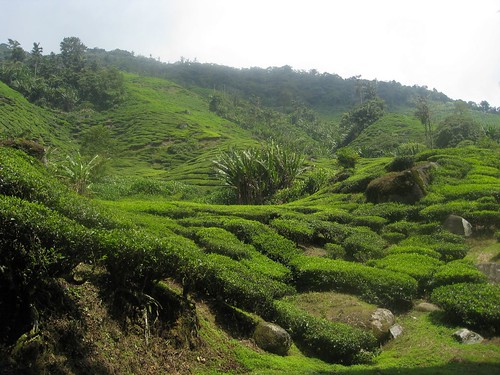
From the end of the trail it's another 7km's to the Boh tea plantation, which according to the book was "a gentle, uphill slope". I suppose this depends our your measurement of "gentle". Luckily for us about 3kms into the hike, a nice fellow with a truck stopped and took us the rest of the way up the hill. Tea grows on a small bush and the last 3km's of the walk or so was just fields and fields of little tea bushes rolling over one hill to the next. After walking up to the very top of the hill for a great view, we took the tour of the mill. Here they cut, roast and bag up the loose leaves and ship the bags to Kuala Lumpur for packaging and then shipping. Apparently Boh tea is only marketed in Malaysia and Japan, but they have plans to expand into Europe in the near future. After sipping on our tea and sharing a slice of apple pie (they need to work on the crust a bit) we made our way back down to the hill until the bus came by and took us back into Tanah Rata.

Tanah Rata itself is not very large, you can walk from one end to the other in about 10 minutes. Most of the town consisted of hotels and restaurants, obviously catering to tourists and visiting locals (it's apparently a nice getaway location for Malays from KL for the weekends.) With several options for dining to choose from, including the all important Starbucks (surprisingly it's just as overpriced here as it is anywhere else, $4-$5US where the shop next door will sell you a coffee for about $1US), we opted on a nice little place called Restoran Kumar. Most of your options in Malaysia so far for food come from three main camps - Indian, Chinese, or local Malay - which appears to be a combo of the two to some degree. We decided to split a Tandoori chicken and some Naan, which was so tasty we decided to come back again the next night!

Day 2: We bite the bullet and take the tour

Taking tours are not really our cup of tea, pun intended, but we figured the only way to see the Raffelasia, one of the largest and rarest flowers in the world, was to take one. Of course the tour also included a visit to...the Boh tea plantation :-). As with most tours, they try and cram in as many things as possible so they can attract the most number of people that you really cannot appreciate what you are seeing/doing until it is time to move on to the next thing. Our tour not only included the flower and the Tea plantation, but also a stop at a little "native" village, dart blowing, swimming in a waterfall, a strawberry farm, rose garden, butterfly room and reptile garden. After driving another hour and a half, we arrive at the Orang Asli village and give dart blowing a try. Tracy proved to be the better hunter, hitting the target squarely while Jason's attempt sailed into the hill beyond the target. After wandering around the village without purpose or reason for about 20 minutes it was time to start the trek to the flower. Our driver informed us that today was his day "off" and he needed to rest so a local village boy, aka gangster, was going to take us to the flower. Judging by the guides shoes, we all thought he had a lot of "days off" and never really took the hike. After walking up the dirt road for about 45 minutes, we hiked through the jungle for another 45 minutes until we came to the spot of the Raffleasia. The flower itself only blooms once every 4 years or so and will only grow if it has just the right amount of rainfall, not too much and not to little. Spanning about three feet across, it really was impressive, considering that next to it was one yet to bloom and it was only about 6in across. After a quick dip into a really cold waterfall, it was off to the tea plantation. At least it was the "other" Boh tea plantation and this one was much more geared to tourists than the one from the day before. After taking the tour, again, and having a "spot of tea" again, it was back in the van and off to the Butterfly/Reptile/Rose Garden, aka crappy tourist trap. At least it was only 5RM per person and the little two minute presentation of bugs and reptiles was entertaining. Other than that, total waste of time - unless you enjoy looking at the exact same butterfly over a hundred times, a lot dead and the ones living might as well be dead - hard to tell the difference. The tell tell sign of a well run establishment has to be the "graffiti" cactus - names and initials carved into the sides of all the cactus lining the walkways. Finally ending our day of fun filled touring we stop at the Strawberry farm. Interesting that they grow them above ground in nice little rows. I guess they prefer it this way so they can get the red all the way around the fruit as opposed to the one side lighter than the other. The saving grace of this stop and pretty much the entire afternoon was that the strawberry shake was pretty good and we met a Swiss man named Claudio who is traveling the world by motorbike and had some nice recommendations for us in Indonesia. After stopping into Kumar's again for some Indian and our first try at Murtabak, a local dish that is similar to on omelet only with some type of bread holding it together, we pack up and get ready to head out to our next stop in the morning, the Perhentian Islands!